The Destruction of Reason by Georg Lukacs
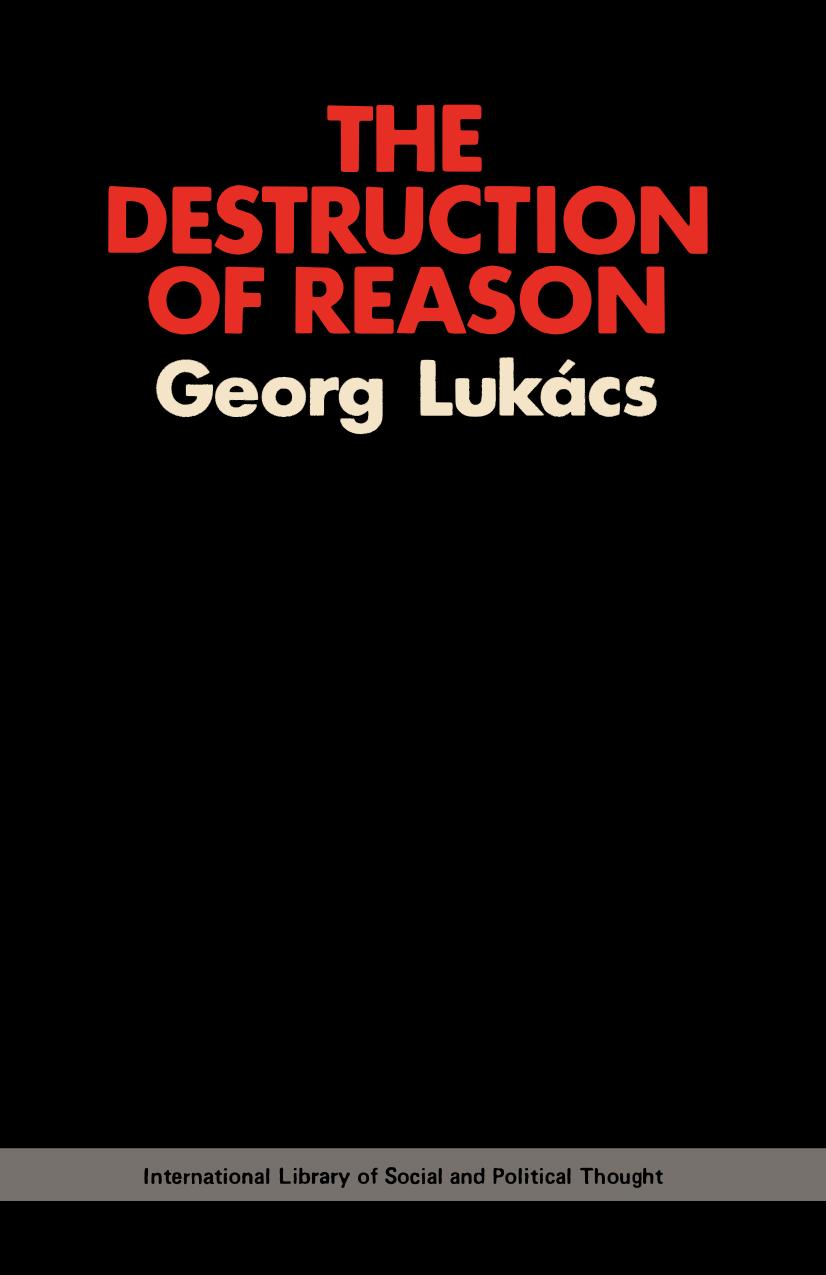
Author:Georg Lukacs [Lukacs, Georg]
Language: eng
Format: epub, pdf
ISBN: 9781839761843
Google: Fzg7EAAAQBAJ
Publisher: Verso Books
Published: 2021-03-16T23:26:13.598109+00:00
3. Vitalism in the Pre-War Period (Simmel)
In his whole mentality and education Dilthey was a man of the pre-imperialistic period, but he sensed the new problems very strongly in advance and subsequently passed into this problem-complex. In Simmel, his junior by twenty-five years, the intellectual tendencies of pre-war imperialism were concentrated in an incomparably more salient and immediate way: he was truly the child and representative of the new period.
As in Diltheyâs case, to be sure, Kant and positivism formed his philosophical starting-point. But with Simmel we are dealing with the positivism of a more advanced age, and no longer with Comte, Taine or Buckle. Influenced very strongly by Nietzsche, Simmel attained eminence in the struggle against the philosophical and social consequences of historical materialism. From the outset, his thought spontaneously ran parallel to Anglo-American pragmatism and developed a close affinity with Bergsonian tendencies. His Kantianism too had a different, more imperialistic nuance: he was resolutely subjectivistic, and the objective reality of the external world was already, for him, no longer a problem at all.
On the contrary, the chief bias of his epistemology was an energetic battle against every kind of imitation, every kind of mental reproduction of reality as it really is. Thus he said of historical knowledge that it was âno mere reproduction but an intellectual activity which fashions out of its material ⦠something that, in itself, it does not yet constituteâ.26 With Simmel we see perfectly clearly how the Right-wing critique of the narrowly mechanical theory of imitation, given an idealistic basis and a dominance of formal logic, necessarily led to vitalistic subjectivism. Simmel, like many modern idealists, saw that the old materialismâs mechanical theory of imitation was unable to solve complicated problems of concreteness in a satisfactory form. And as with many modern idealists, this observation caused him to reject the knowability, indeed the existence of objective reality. But Simmel was far more decided in this rejection than most of his predecessors or contemporaries. This followed from his vitalistic stance, which allowed him radically to deny any objective reality independent of the subject and yet to confront man with a pseudo-objective external world, because life here offered itself to him as a real intermediary: âLife appears to be the most extreme objectivity to which we may penetrate directly as animated subjects, the farthest and most permanent objectifying of the subject. With life we occupy a position half-way between the ego and the idea, subject and object, person and cosmos.â27 Accordingly he dismissed the epistemological question in its only correct and clear formulation, namely the priority of being or consciousness, in the name of a vitalistic âthird roadâ. The question was to be modified as follows: âDoes consciousness depend on life, or does life depend on consciousness? For after all, life is the being which stands between consciousness and being in general ⦠Life is the higher concept and higher actuality beyond consciousness; this is life at all events.â28 Epistemologically speaking, real life belongs to being and experience to consciousness.
Download
This site does not store any files on its server. We only index and link to content provided by other sites. Please contact the content providers to delete copyright contents if any and email us, we'll remove relevant links or contents immediately.
| Anthropology | Archaeology |
| Philosophy | Politics & Government |
| Social Sciences | Sociology |
| Women's Studies |
Born to Run: by Christopher McDougall(7132)
The Leavers by Lisa Ko(6950)
iGen by Jean M. Twenge(5419)
Sapiens by Yuval Noah Harari(5375)
Spare by Prince Harry The Duke of Sussex(5202)
The Kite Runner by Khaled Hosseini(5188)
Machine Learning at Scale with H2O by Gregory Keys | David Whiting(4317)
Bullshit Jobs by David Graeber(4197)
Never by Ken Follett(3963)
Goodbye Paradise(3813)
Livewired by David Eagleman(3778)
Fairy Tale by Stephen King(3403)
A Dictionary of Sociology by Unknown(3088)
Harry Potter 4 - Harry Potter and The Goblet of Fire by J.K.Rowling(3077)
The Social Psychology of Inequality by Unknown(3039)
Will by Will Smith(2930)
The Club by A.L. Brooks(2928)
0041152001443424520 .pdf by Unknown(2850)
People of the Earth: An Introduction to World Prehistory by Dr. Brian Fagan & Nadia Durrani(2740)
